
Workflow EconomicsEvery Case, Priced FromWhat Happened to It
What if the granularity of operational control, one Case at a time, met the rigor of financial planning and cost control, from the model to the monthly variance? Operations knows every visit, every re-entry, every hand-off, and cannot put a dollar on any of them. Finance knows every dollar, closed a quarter later, and cannot say which Case it belongs to.
Workflow Economics is the ledger they have never shared: one set of recorded facts, priced once, read by both rooms.
Built for health plans and the partners who run their clinical operations.
One Set of Recorded Facts, Priced Once.
Every Case already records what happened to it. Give each kind of recorded fact one price and every Case prices itself. Write down what a Case should cost, and the difference explains itself, workflow step by workflow step.
Worked example throughout: Prior Authorization , 2.5M Cases a year, 208,000 a month. Every figure is modeled, not reconciled .
Control the Cost of Today’s Work. Model the Change. Then Run the Work Against the Target You Set.
Control asks what now. Modeling asks what if. Target execution asks are we on track. All three read the same ledger, so they can never disagree about the facts.
One Workflow. Every Assumption in One Place.
A Cost Plan is opened once per workflow. Models sit on the left, benchmarks on the right, and the two lists never touch: hold three models against one target, or one model against three targets, without any of them rewriting the others.
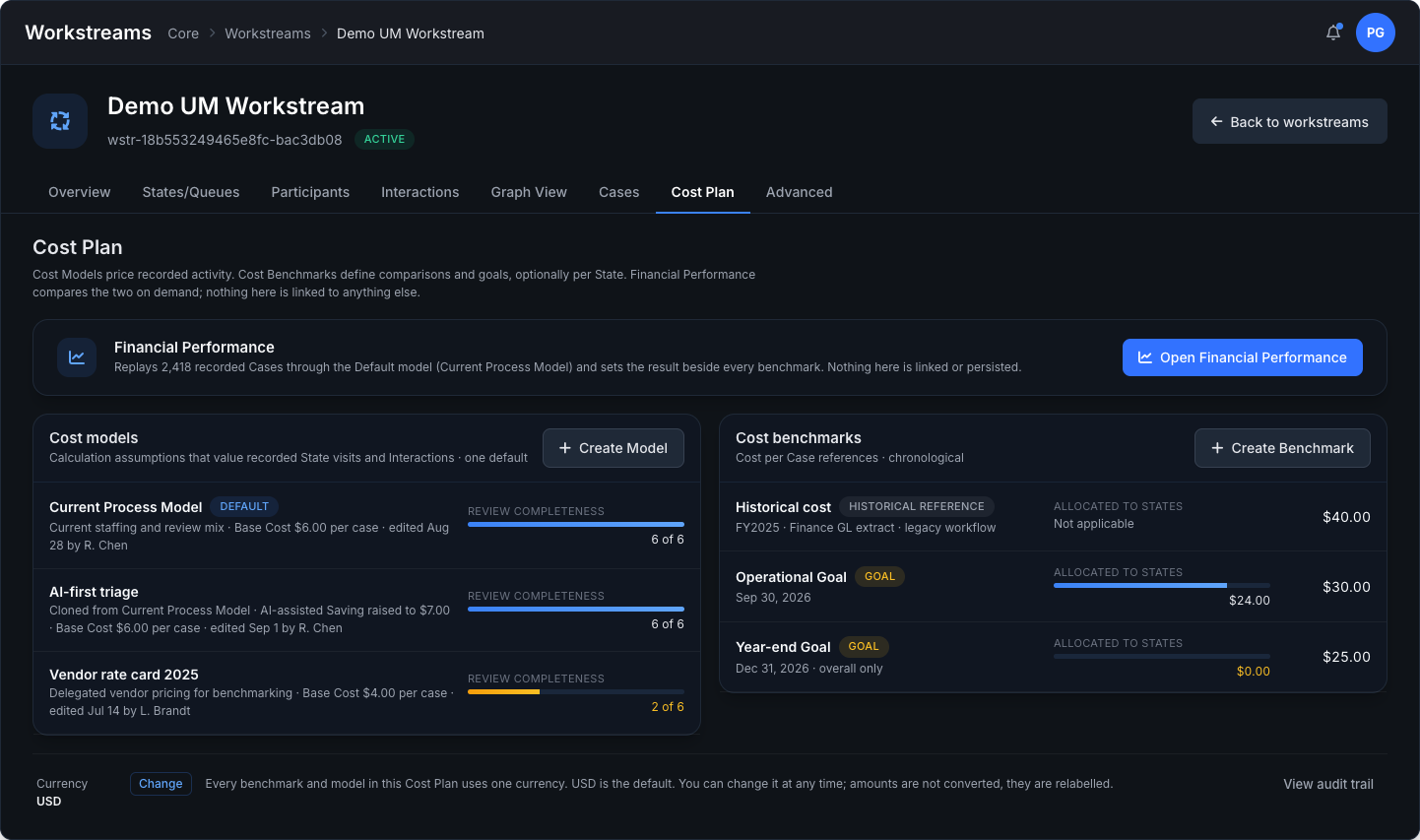
* Cost Plan module design, Prior Authorization example. Screens use product terms: State = workflow step, Interaction = action.
Models · calculation only
Each model shows reviewed over all rules. One is Default and opens first in Financial Performance.
Benchmarks · reference only
Historical references and targets. Each target shows how much of its cost per Case is committed to steps.
Neither changes the other
Editing a target changes the report; it never changes a price. Cloning a model never touches a target.
Currency fixed at creation
Changing it later relabels amounts; it never converts them.
A Price List Can Be as Coarse or as Fine as What You Know.
Start flat, refine by workflow step, then by action. A flat model is a legitimate first model, and every refinement is a decision someone signed. Review completeness, 6 of 8 actions here, tells both rooms how much of the workflow has actually been decided.
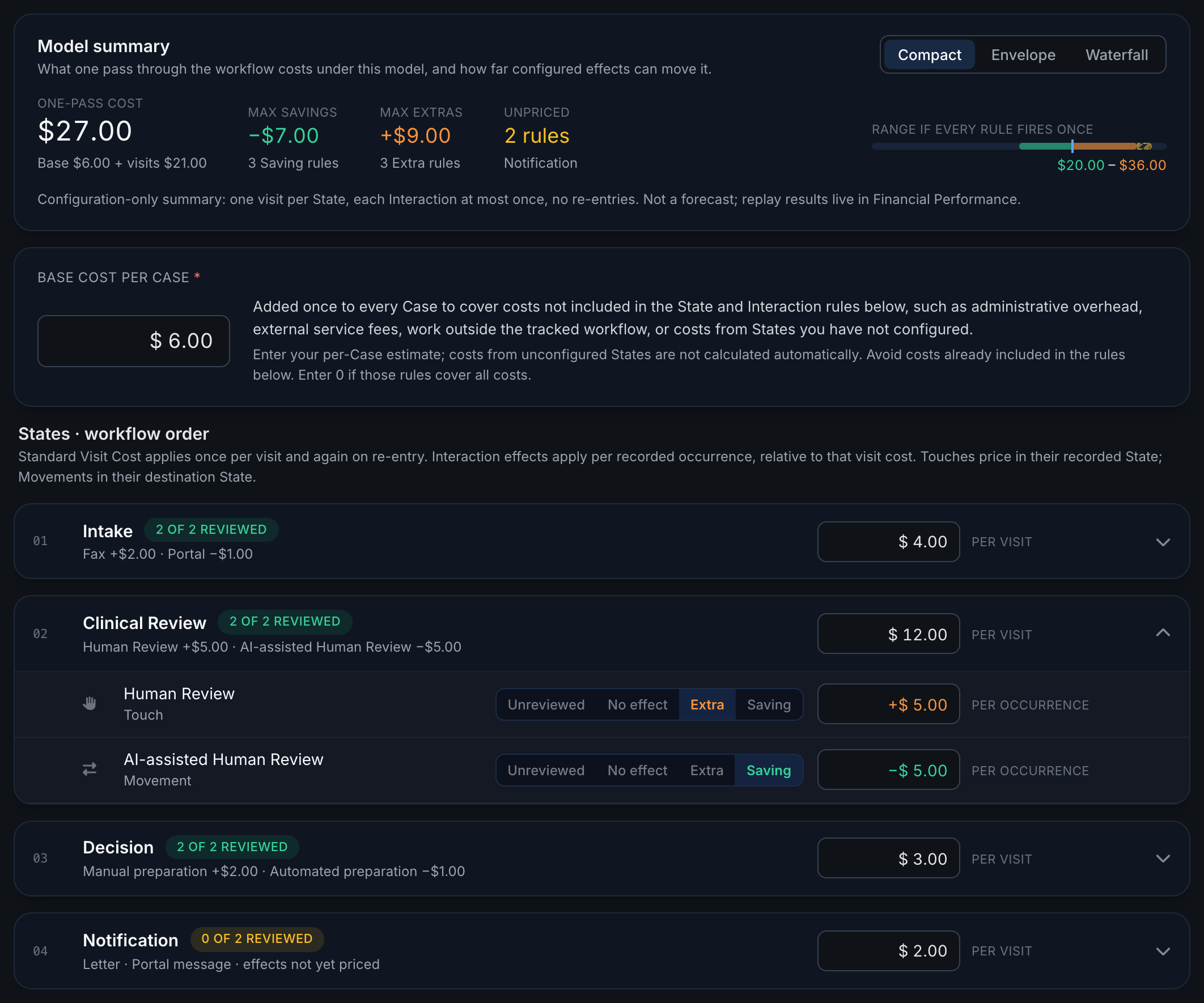
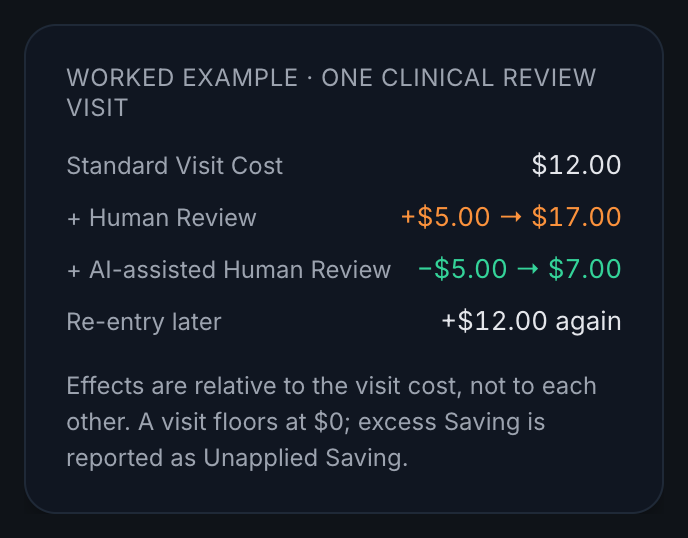
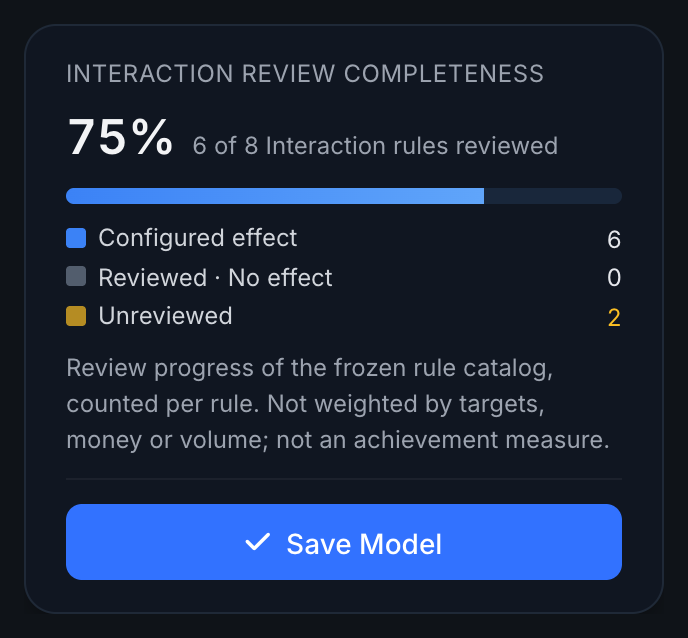
* Cost Plan module design, Prior Authorization example. Screens use product terms: State = workflow step, Interaction = action.
Depth 1 · Per Case
A flat cost for everything no step captures: overhead, postage, external fees. Enter 0 once the steps below carry it all.
Depth 2 · Per step visit
A standard cost each time a Case enters the workflow step. Coming back pays it again; that is how rework shows up.
Depth 3 · Per action
A surcharge or a credit per occurrence, relative to the visit. Exceptions add; automation and AI subtract. A visit never prices below $0.
Review completeness
Every action carries one of four review states. Reviewed over all actions is shown on the model, never implied.
Same Facts. Only the Prices Moved.
Copy the price list, change an assumption, replay the same Cases. A new tool, a vendor rate card, an AI or automation step: each is priced on the work that actually happened, before anyone commits.
- Today’s staffing and rates
- Human Review +$5.00 on 800 per 1,000 Cases
- Second Clinical Review visit on 200 per 1,000
- AI-assisted Review −$5.00 on the first visit
- Standard Clinical Review visit unchanged
- Same re-entries: the record decides, not the model
- Clinical Review visit at the delegated rate
- Peer-to-peer call unchanged
- 5 of 8 actions reviewed; 3 price as $0 and are flagged
* Built from the Operon.Cloud Cost Plan module design; Financial Performance prices one selected model at a time; these three cards show three selections of the same window, not a side-by-side report.
Clone keeps the snapshot
Workflow steps and actions carry over with their prices. You edit only what the alternative changes.
One model at a time
Financial Performance prices one selected model per view. Switch the selector to reprice the same window.
Targets stay put
Benchmarks belong to the Cost Plan, not the model. Every alternative is judged against the same $30.00 target.
Facts are never edited
A visit happened or it did not. Only the price attached to it can change, and it reprices every Case the same way.
Commit at the Level You Can Own: One Figure for the Case, a Share for Each Step, and a Date.
Finance sets the figure; operations owns the shares. The $15.00 for Clinical Review is a cohort average for that step, not a cap on any one Case. It gives the step’s owner a number to run to, and gives the target a shape the modeled cost can be laid against.
What a Case used to cost. One figure, no dates, no shares. It sets the baseline for improvement and draws the dashed line on the trend.
Example: FY2025 · Finance GL extract · legacy workflow.
What a Case should cost, and by when. Optionally allocated to workflow steps; whatever is not allocated stays as the unallocated share.
Several targets can coexist. All appear on the trend; one drives the comparison. Year-end target: $25.00.
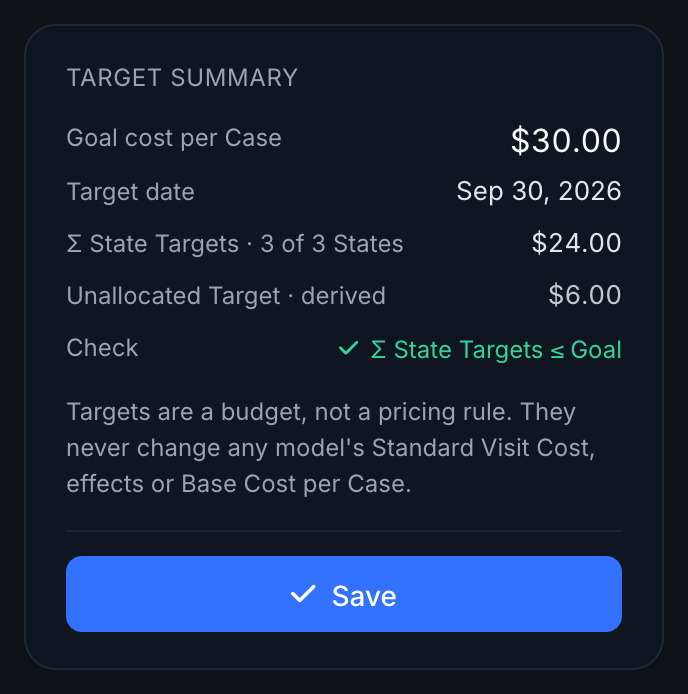
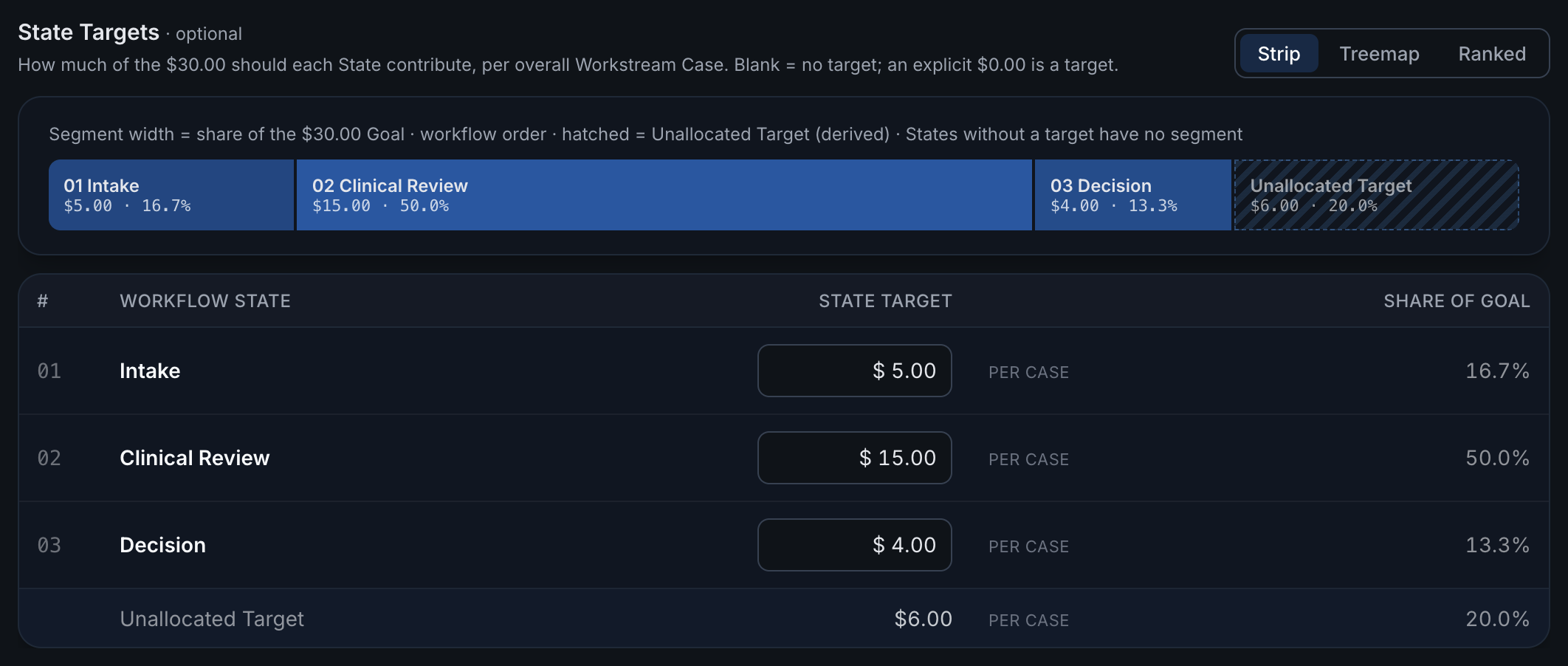
* Cost Plan module design, Prior Authorization example. Screens use product terms: State = workflow step, Interaction = action.
Shares may not exceed the target
Over-allocation blocks Save. Nothing is capped or redistributed for you.
Unallocated is derived, never typed
Shares are entered in dollars per Case; percentages and the remainder are shown, not typed.
A target with no shares is allowed
An overall-only target renders entirely as unallocated. Refine it when the step owners are ready.
Last year’s $40.00 is a benchmark too
Historical references never carry shares. They anchor the improvement figure and the progress ratio.
Lay the Target and the Modeled Cost on One Scale, and the Gap Explains Itself.
Finance reads the top row: 85% of the way from last year to the target, $1.50 short. Operations reads the middle row: Clinical Review is $1.40 over its share, and the reasons are named. Per Case tells you the rate; total cost by month tells you the money, against the budget the target implies.
By workflow step: target, modeled, gap, visits per Case and repeats, gross extras and savings. By action: configured effect × recorded occurrences. Every dotted count opens the Cases behind it.
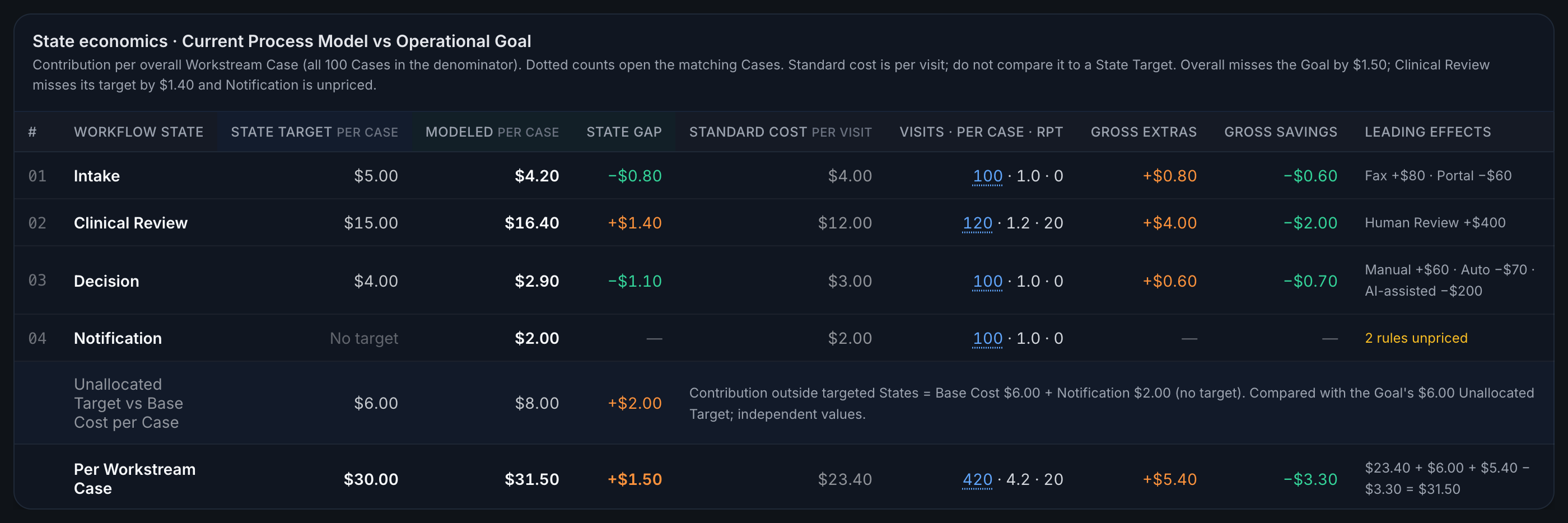
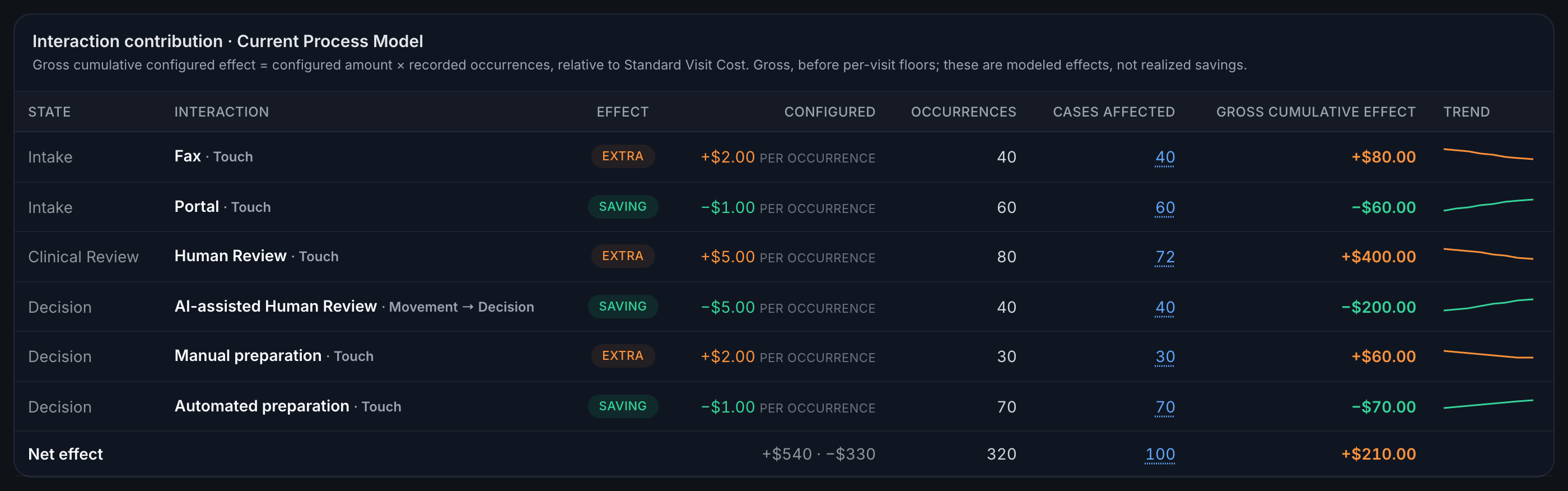
* Cost Plan module design, Prior Authorization example. Screens use product terms: State = workflow step, Interaction = action.
Improvement · H − M
How far modeled cost sits below last year. $8.50 per Case, $21.3M a year.
Gap · M − G
How far modeled cost sits above the target, broken down per workflow step when the target carries shares.
Progress · (H − M) / (H − G)
Share of the distance from last year to the target already covered. Not clamped; over 100% means the target is beaten.
Booked to the month started
A Case’s whole modeled cost lands in its first-touch month, so months are comparable and the budget line is Target × Cases.
The Same Ledger at Every Altitude: a Month, a Cohort of Cases, One Case.
"Why did August move?" is a finance question. "Why did this Case cost $38?" is an operations question. Both are answered from the same rows, so the monthly figure and the single Case can never disagree.
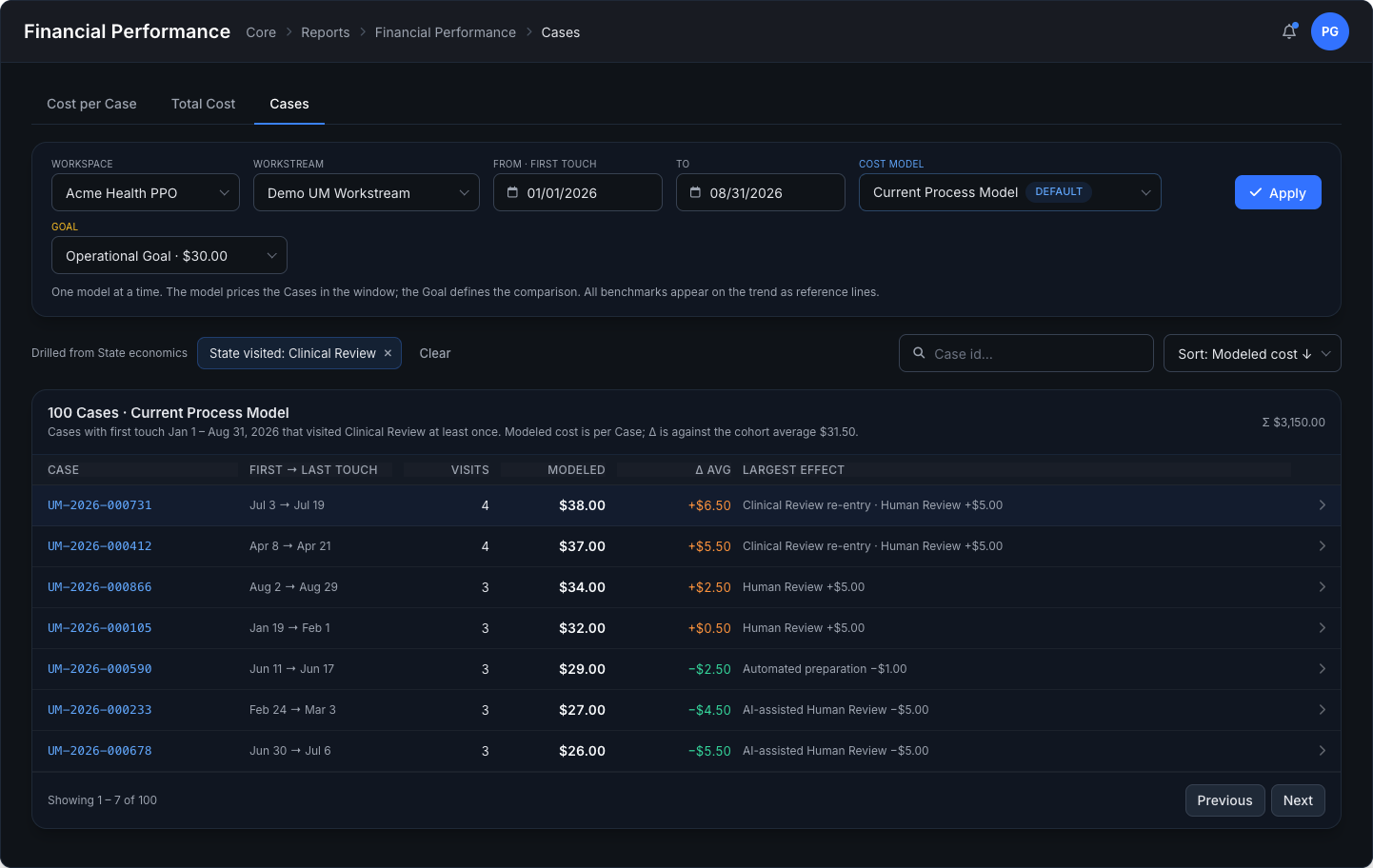
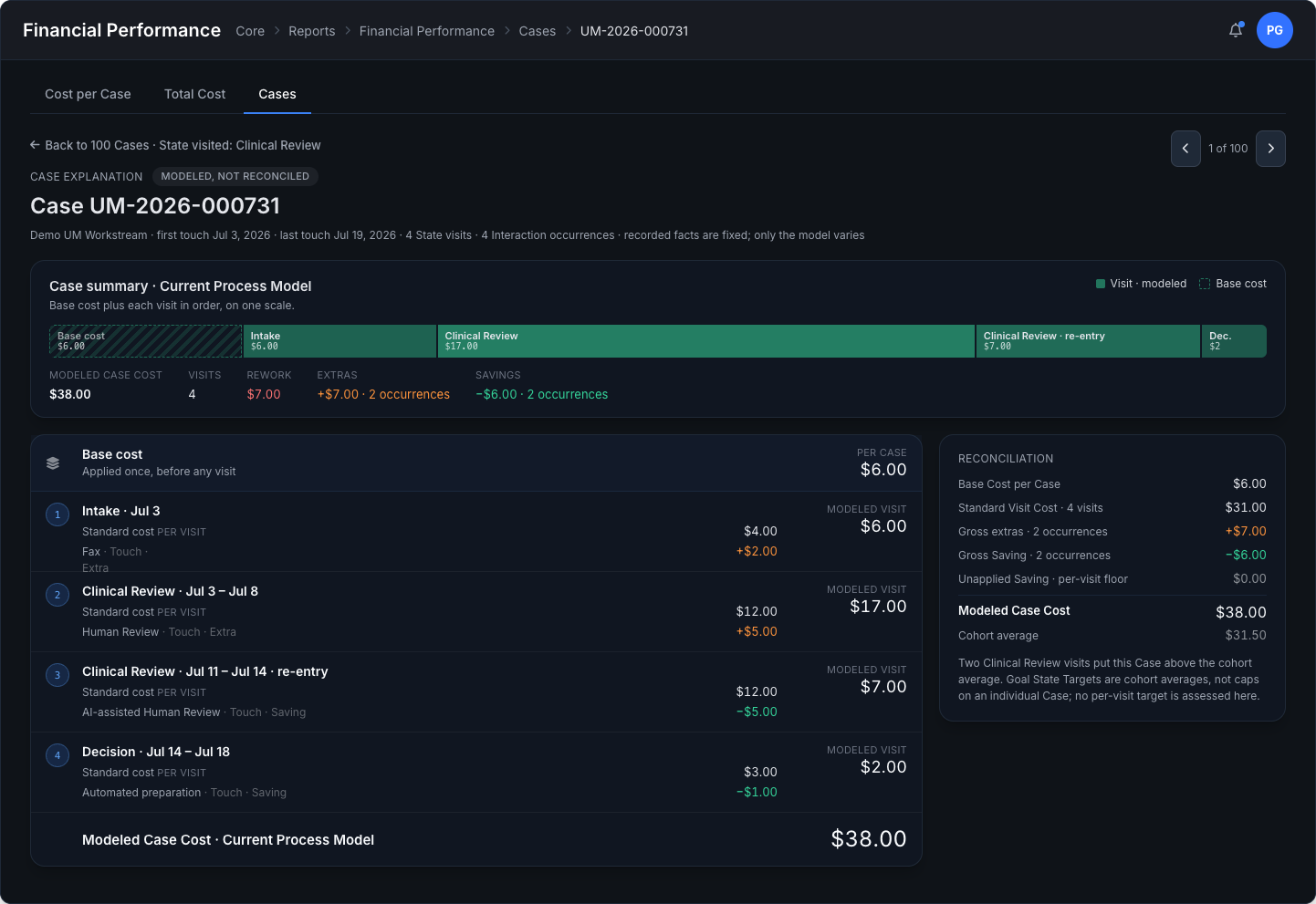
* Cost Plan module design, Prior Authorization example. Screens use product terms: State = workflow step, Interaction = action.
Altitude 1 · by month
Cost per Case by the month a Case started. Click a month to open the cohort behind it.
Altitude 2 · a cohort
Every count is a door. At 208,000 Cases a month those doors open on 150,000 and 42,000 Cases, sorted by cost.
Altitude 3 · one Case
Flat cost, then each visit in order with its actions. The second Clinical Review visit is the recorded re-entry priced at the standard rate.
Zoom in, the number never changes
The monthly figure is the sum of its Cases. Nothing is sampled, smoothed or interpolated on the way down.
A Cost Model Is Only Useful While Both Rooms Trust It. These Rules Are How It Earns That.
Two inputs, one boundary. Recorded case activity comes from operations; agreed prices come from finance; what comes back is modeled cost, labelled as such. Each rule trades a little convenience for a number that can be defended across the table: nothing inferred, nothing smoothed, every assumption visible where its effect appears.
Recorded case activity
The same case record Operational Control runs on. Nothing is entered by hand; nothing is sampled.
Agreed prices
Entered once in the cost model, reviewed action by action. Where the price comes from is your call; the model shows where it is applied.
Modeled, not Finance Actual
Every figure carries the label. It explains the ledger; it does not replace it. Finance keeps the books; this tells them what is inside.
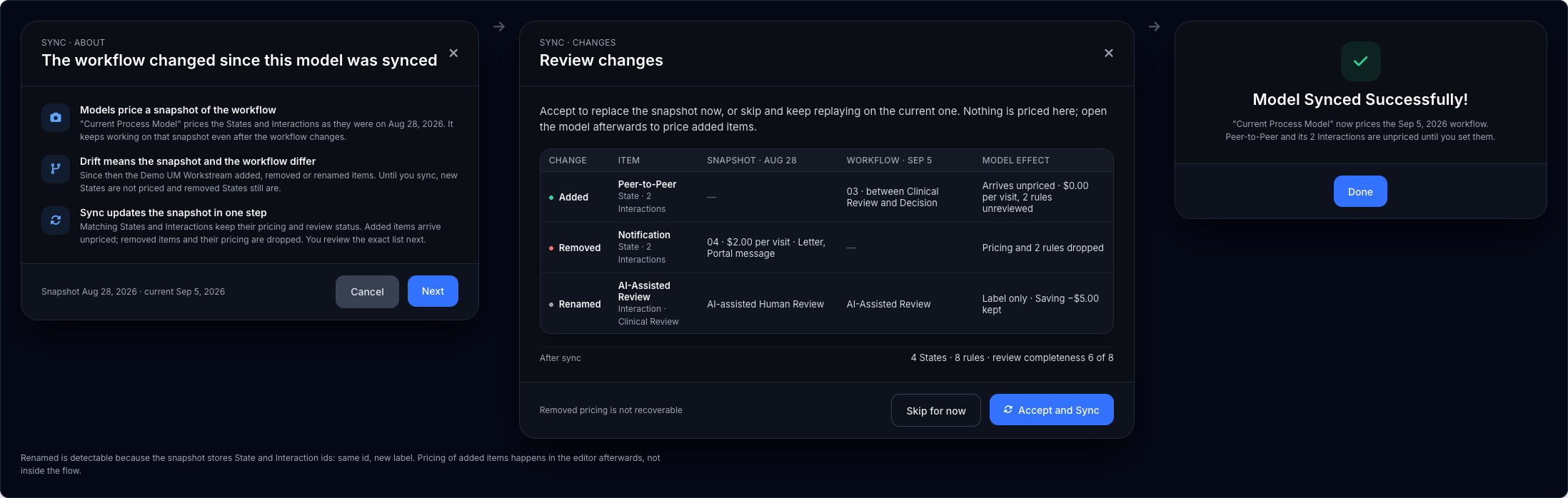
* Sync flow from the Cost Plan module design: when the workflow changes, the price list says so and asks both rooms to decide.
Modeled, not reconciled
Every figure carries the label. It explains the ledger; it does not replace it.
Facts are never edited
A visit happened or it did not. Only the price attached to it can change, and changing it reprices every Case, past and future, the same way.
Unpriced means zero, and says so
An action nobody has reviewed contributes nothing and is flagged wherever it would have counted. Review completeness is shown, not implied.
No silent math
Targets are never capped or redistributed for you. Nothing is interpolated toward a target. A month with no Cases reads unavailable, never $0.
Tied to a version of the workflow
When workflow steps or actions are added, removed or renamed, the price list says so and asks both rooms to decide. What still matches keeps its price; what is new arrives unpriced.
Not a forecast
The model summary assumes one visit per step and each action once. Only the record produces results, and only for Cases that actually ran.
See Where Cases Break
Cost tells you what a step is worth; control tells you where it stalls. Live breach risk, queue wait, rework loops and who has each Case right now, on the same recorded work that Workflow Economics prices.
Explore Operational ControlProve What AI Is Delivering
AI-touched Cases are priced by the same model as the humans and vendors around them. The business case is a line in the ledger, confirmed or denied by next month’s record.
Explore AI Adoption & ROINow Take a Workflow You Already Run
No pitch deck. No pressure. Just a conversation about what you're trying to solve and whether we're a fit.
Good fit if you're:
- Trying to answer "what does a Case cost?" without a three-week spreadsheet
- Setting a cost target and needing each workflow step owner to carry a share of it
- Evaluating a vendor rate card or an AI tool and want it priced on your own Cases first
- Asked to prove AI ROI in the same numbers finance uses
Book a Call
- 30 minutes with our founding team
- A sample walkthrough of the Prior Authorization example: model, target, month, Case
- Honest assessment of fit. A 5-day bootcamp on your own data comes after, if it makes sense.
Or email us at sales@operon.cloud